


At Kenkay Real Estate Holdings, every potential project is evaluated with the same precision we bring to engineering: data-driven, risk-aware, and return-focused. Our deal analysis process is built around a proprietary evaluation model that ensures each flip meets strict ROI and cash flow standards before we break ground.
Whether you’re an investor seeking strong returns or a hard money lender evaluating collateral risk, our approach is designed to instill confidence that your capital is going into the right deal.
Step 1 — Acquisition Criteria: Buying Right from the Start
We start by identifying properties that fit our acquisition parameters:
- Target Locations: Established or emerging neighborhoods with strong resale activity.
- Discounted Purchase Price: Well below comparable market value, leaving room for renovation and profit.
- Clear Value-Add Potential: Cosmetic or functional improvements that will significantly raise resale value without overcapitalizing.
Step 2 — Running the Numbers with Our Deal Analysis Template
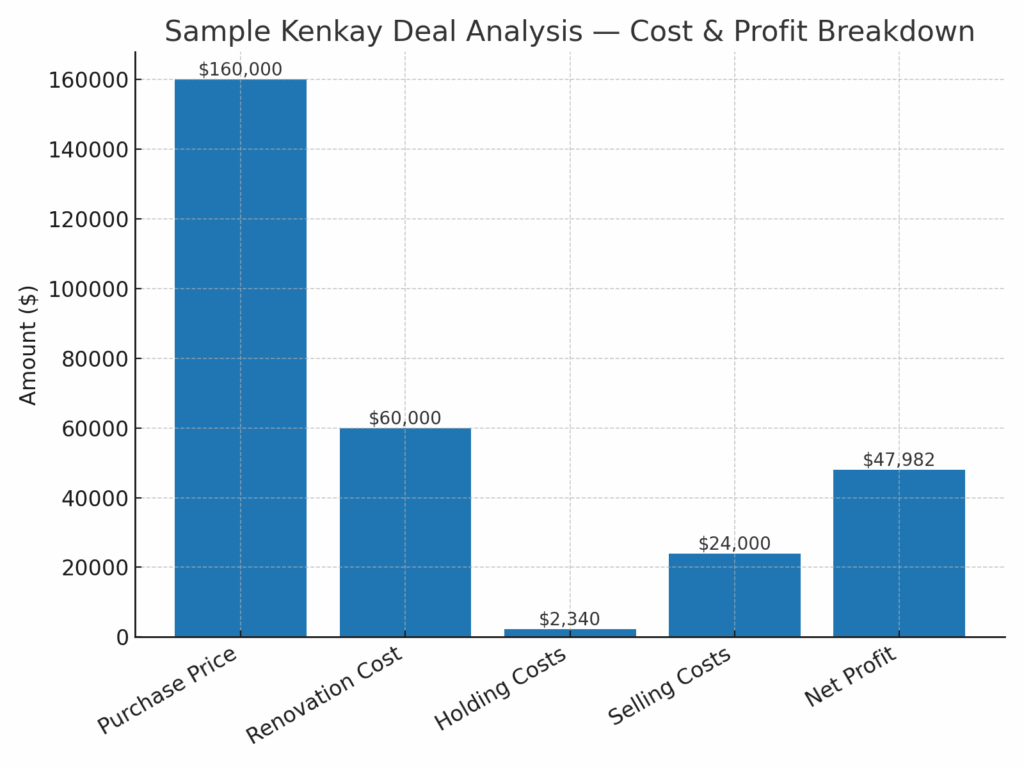
Our in-house Deal Analyzer combines market research with real-time cost and revenue assumptions to produce a clear profit forecast.
Key metrics we evaluate:
| Metric | What It Tells Us | Our Target Threshold |
|---|---|---|
| Purchase Price | Entry cost for the property | 65–75% of ARV minus repairs |
| Renovation Cost | Scope-driven construction estimate | Aligned with value-add strategy |
| Holding Costs | Taxes, insurance, utilities, interest | Minimized with efficient timelines |
| Selling Costs | Agent commissions, staging, closing fees | Typically 8–10% of resale price |
| Expected Sale Price (ARV) | After-repair value based on comps | Conservative appraisal-based |
| Flip ROI (%) | Return on total invested capital | 20% minimum target |
| Total Cash Return | Net cash profit post-sale | Sufficient to justify risk |
Step 3 — Stress Testing for Risk Management
We don’t just look at the best-case scenario — we plan for the “what ifs.”
We run sensitivity tests to see how the deal holds up if:
- ARV drops by 5–10%
- Renovation costs run over budget
- Market absorption slows, increasing holding periods
This approach ensures investor capital protection and positions us to make fast, informed decisions.
Step 4 — Beyond the Spreadsheet: On-the-Ground Validation
While the numbers matter, the story behind the property is equally important. We conduct:
- In-person inspections to uncover hidden repairs
- Contractor walkthroughs to validate the renovation scope
- Neighborhood trend analysis to confirm market demand post-renovation
Step 5 — The Kenkay Differentiator: Engineering Precision Meets Real Estate
Coming from an engineering background, we approach flips like product design:
- Every dollar spent must contribute to structural integrity, functionality, and buyer appeal
- We implement process improvements that speed up renovations and cut waste
- We document each project with before-and-after metrics for future investor transparency
Step 6 — Investor & Lender Transparency
Before moving forward, we prepare a Deal Brief for investors and hard money lenders:
- Executive summary of the opportunity
- Side-by-side projections for conservative, realistic, and aggressive outcomes
- Defined exit strategy (sale, refinance, or rental conversion)
Why This Matters to Investors and Lenders
Our method isn’t just about finding profitable deals — it’s about building predictable, repeatable success.
- For Investors: Higher confidence in returns and reduced downside risk.
- For Hard Money Lenders: Detailed, data-backed plans that protect collateral and ensure timely repayment.
Bottom Line:
At Kenkay Real Estate Holdings, we don’t gamble with projects — we engineer them for profitability. If the numbers don’t meet our thresholds and the risk isn’t managed, we walk away. This discipline is what makes our fix-and-flip deals stand out in the market.